Publication news!
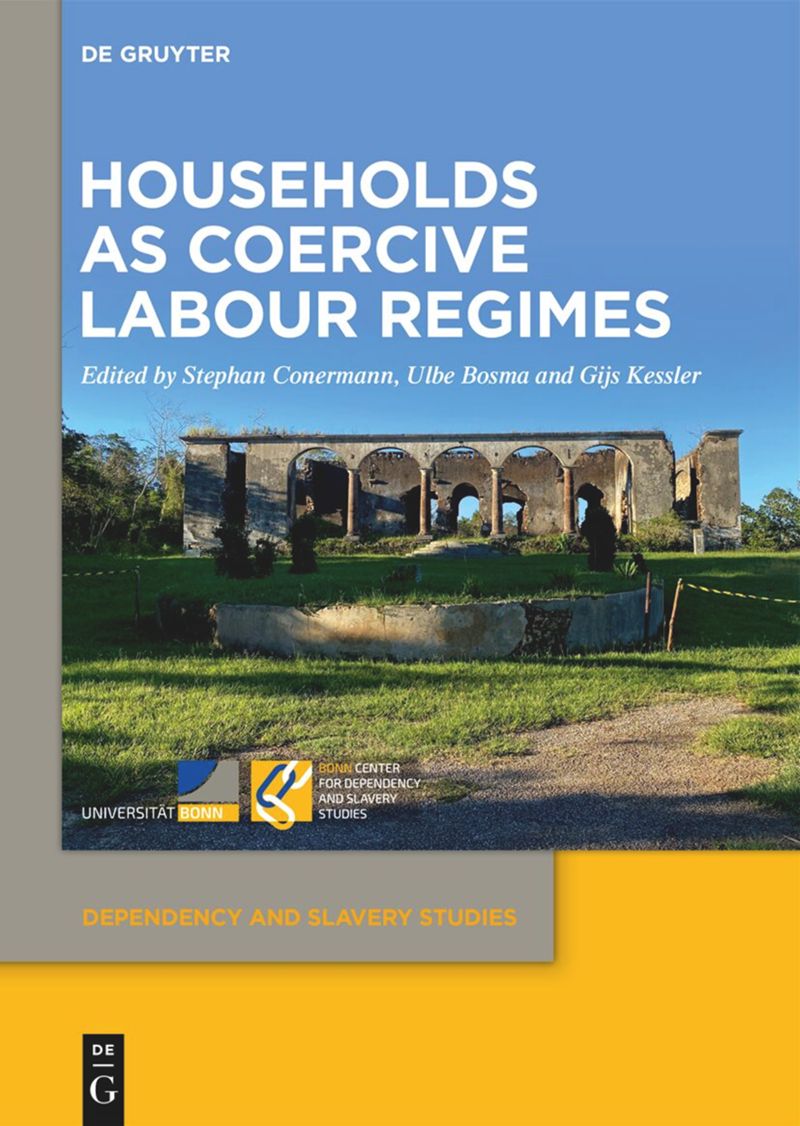
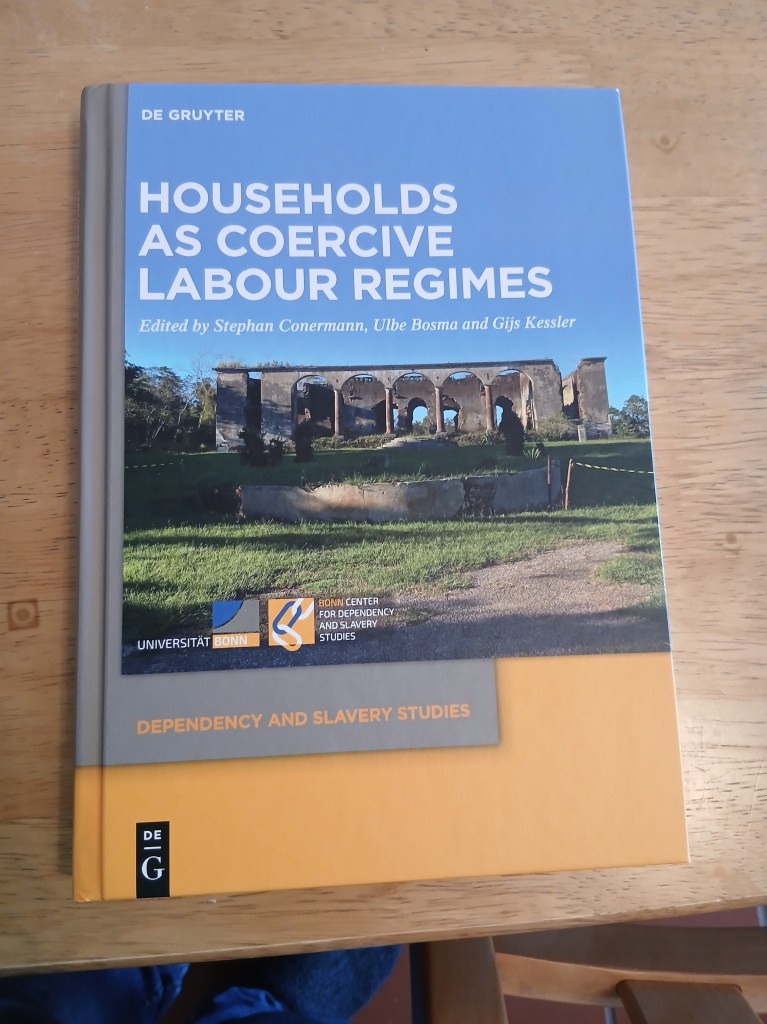
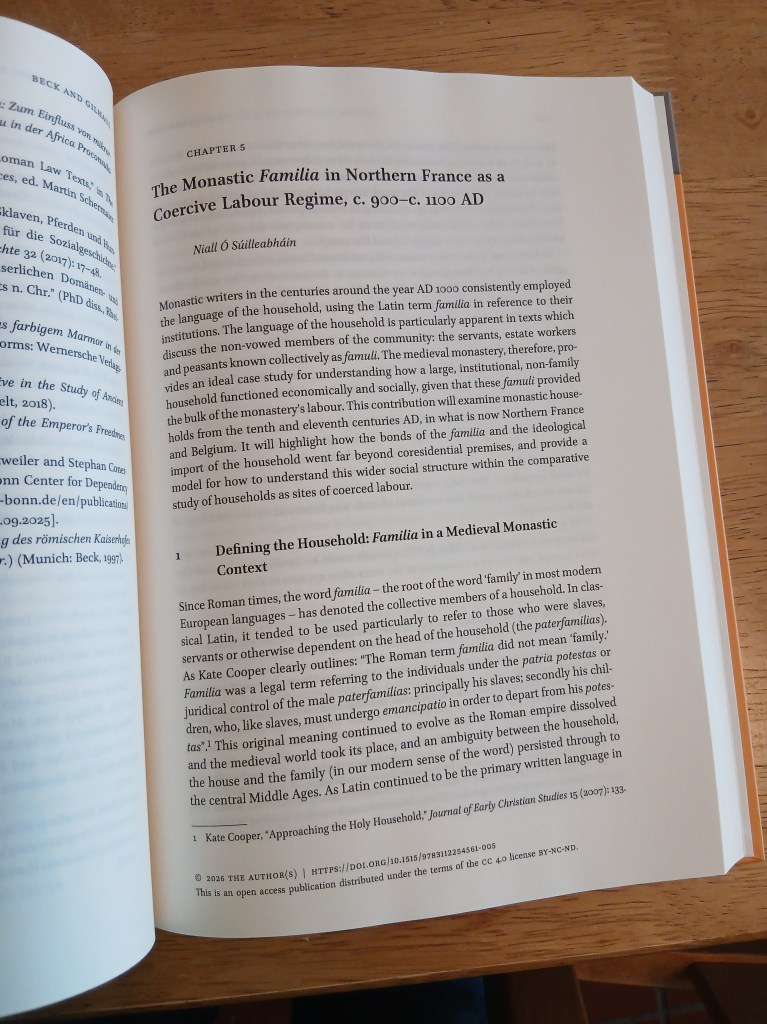
In the first major announcement of the week, I was delighted to receive in the post today my hard copy of a new edited volume by Stephan Conermann, Ulbe Bosma and Gijs Kessler, Households as Coercive Labour Regimes, published by De Gruyter as part of the University of Bonn’s Dependency and Slavery Studies series, in which chapter 5 – on ‘The Monastic Familia in Northern France as a Coercive Labour Regime, c. 900 – c. 1100 AD’ – was authored by yours truly. Technically, this was published yesterday (August 31st), and has actually been available only for about two weeks now, so this post is really just celebrating the arrival of my own copy. Given that it’s my first publication directly addressing the issues of servitude and unfreedom, however, a topic I’ve been working on for about half a decade, I still think it deserves some celebration!
In the flesh!
The volume as a whole is the result of a very enjoyable conference in at the International Institute for Social History in Amsterdam in November 2023, which brought together historians from a very wide range of fields to discuss the ways in which households acted as frameworks for labour relations, particularly for dependent, forced and enslaved workers. There were some memorably heated exchanges at times, particularly between some of the more quantitatively-minded modernists (who wanted to find uniform definitions and statistically-comparable case studies) and us pre-modernists, who more often emphasised the different ways in which our chosen societies conceived of family and household, but this was ultimately very intellectually fruitful, I think. The goal was to try to find shared approaches to the methodological problems posed by trying to study something often thought of by historians as quite large-scale and abstract (labour relations) within the very intimate context of the household, and I think in the end we made good progress here (as you can read in the collection). What helped this immensely was that the conference was primarily devoted to discuss; we wrote and circulated papers in advance, gave a short 5-minute summary presentation, and the rest of the time was given over to questions and debate. While it’s an intense model, it’s one I think more conferences and workshops should think about adopting, particularly when you have a clear set of common research questions.
The collective goal – how can we compare these kinds of labour formations across time and space – continued to be a major objective as we worked to turn our papers into chapters. There was a level of editorial involvement and direction in the writing of my chapter that I hadn’t experienced before; I certainly wasn’t interfered with in an intellectual sense, but the editors were very clear in providing guidelines to us as authors about what kinds of questions we should address and the sorts of information we should provide in order to allow for cross comparison between case-studies, even if it might seem incidental to us as subject specialists. In the end I think this has created quite a cohesive volume, even if some of the methodological tensions I mentioned above are not quite erased.
So what was my contribution? Essentially, I had a look at monastic famuli (i.e. non-vowed servants and dependents) from post-Carolingian Francia and what kinds of labour functions they provided within the monastery itself, as well as its outlying estates. Some of the questions I answered were common to the volume as a whole (e.g. what kinds of coercion were present? how did one enter or exit the familia?), but I deal with how to fit something like a familia – which literally translates as a household, but often doesn’t conform to many/any modern social scientific definitions – into a wider comparative analysis. In doing so, I proposed (in what is likely the most original idea in the chapter) that we think of the monastic familia as the inverse of the modern prison. One of the major thinkers who has worked on typologies of households in the social sciences was Peter Laslett, and one of his major criteria for a household was co-location, i.e. people in the same household live in the same physical place. But he also recognised that there are many cases where people who live in a shared physical space cannot be thought of as belonging to the same household, such as prisoners in a modern prison; Laslett called this kind of formation a ‘houseful’, whose members are termed ‘inmates’. I propose that, in its widest sense, the medieval monastic familia was the inverse of this arrangement: a group of ‘outmates’ who did not share a co-residential space but who “were still strongly associated socially, economically and spiritually” in the same ways a household was. I then go on to suggest that the reason for this formation in the medieval period was ideological, as the ideal of belonging to the household of the monastery’s patron saint was a powerful rhetorical tool used to bind famuli to the institution.
But while I obviously think my contribution is interesting, there’s lots of other excellent stuff in this volume. Contributions which I felt were particularly insightful included Denis Mario Beck and Lennart Gilhaus’ study of the Roman Imperial familia Caesaris of mine workers, Rosamund Fitzmaurice’s contribution on forced labour in postclassical Tenochtitlan and Yaruipam Muivah’s study of the bawi system of dependency in colonial India. Luckily for all of us, the entire volume is available to download for free as an open-access PDF or e-Book; you can also download individual chapters, with mine available here. And finally, a big thanks to Stephen Conermann especially, for handling all the logistics of the editorial process, which was very smooth from the conference right through to publication!


Leave a Reply